In engineering, the most powerful materials often have their strength hidden deep inside. However, that internal strength can only be realized when the material has the proper surface area to interact with its environment.
My journey with Higher Orbits started in the summer of 2023 at the Space Coast Go For Launch! event. At the time, I was doing research with an aerospace engineering professor at Florida Tech, and she encouraged me to attend the event. I was a junior in high school and didn’t fully grasp how much that moment would go on to change my life.
At that event, I became part of Team SuperNOVAs, where we envisioned a way microalgae could be utilized as feedstock for biodiesel production. Our vision took us from winning the Space Coast event to claiming the top spot in the 2023 National Series. By August 2025, our experiment hitched a ride to the International Space Station aboard SpaceX CRS-33. It remained in orbit until February 2026, finally splashing down off the coast of California.
The HIOR_EDU06 mission represented so many of my dreams and aspirations. The launch of my research experiment is something I never even dreamed of accomplishing. Having a research experiment launched into space is a milestone many scientists and engineers spend their entire careers chasing. However, thanks to Higher Orbits, I achieved that before the age of 20.
Today, I’m a rising second-year chemical engineering student at the Florida Institute of Technology. As a chemical engineer, I see chemistry not just in the processes that power our world, but as part of the very fabric of who we are. Recently, while in the lab analyzing reaction rates, I found myself reflecting on the interplay between surface area and performance.
Surface area is critical in engineering for optimizing heat transfer, chemical reactivity, and material usage. In chemical kinetics, we know that increasing the surface area of a reactant accelerates the reaction by providing more sites for interaction. Without that exposure, even the most potent catalyst remains inert. You can think of your surface area as your personal interface with the future. If you only have one point of contact with the world, your growth, or reaction rate, is inherently slow.
Before attending my first Go For Launch!, I had a vision of where I wanted to go, but the path felt daunting and narrow. By taking me to conferences, introducing me to mentors, and showing me what was possible, Higher Orbits massively expanded my surface area. They gave me multiple points of contact with the world, increasing my rate of reaction. Through this expanded interface, I have worked with industry professionals and astronauts, launched my research to the ISS, and collected data that continues to fuel my work here on Earth.
Most rewarding of all, this increased “surface area” has given me the platform to inspire other students to chase their own dreams.
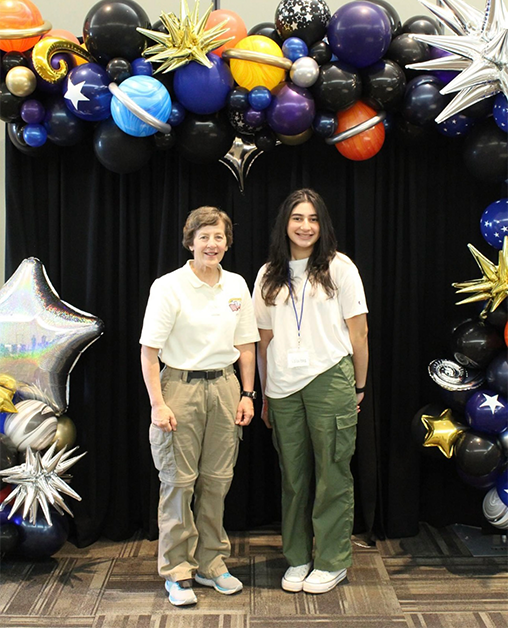
By Valentina Guillen. Valentina is studying chemical engineering at the Florida Institute of Technology.