The universe has always invoked a profound sense of amazement within me. Even as a child, I loved learning about the incredible processes that occur in the cosmos. As I grew older, my interests evolved beyond observation. I wanted to understand the physics that governed the universe and explore the possibilities of humanity’s future in space exploration. I knew that my goal was to unravel the mysteries of the universe, and Higher Orbits helped me hone the real-world skills and tools necessary to do so.
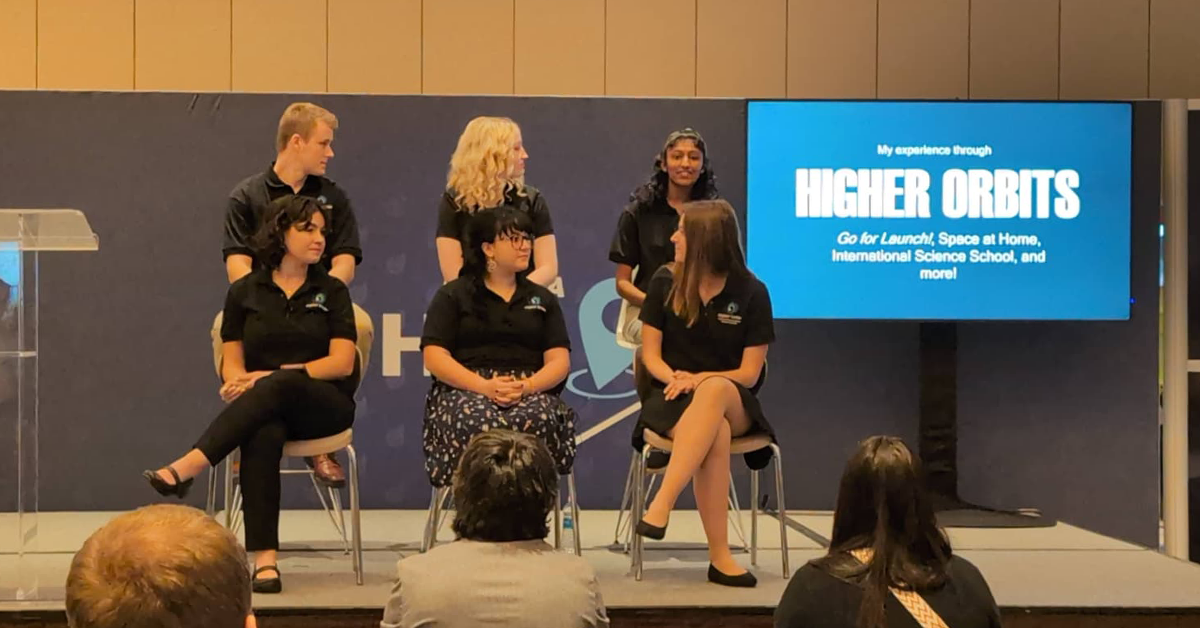
In 2023, I attended Higher Orbits’ Go For Launch! at the Kennedy Space Center, where my team designed a microgravity experiment to be conducted aboard the ISS. Our objective was to investigate unconventional methods for generating artificial gravity on ships used for deep-space travel. In the days that followed, we went down a rabbit hole of research, trying to understand the scientific principles behind the induction of artificial gravity without centripetal acceleration. Though we drew inspiration from existing papers, such as Daniel Beysens’ article, our goal was to explore a unique aspect of gravity generation that could contribute new data to advance understanding in the field.
I was excited to tackle the challenge of designing a feasible experiment. To produce accurate results, we carefully tested a variety of materials, sensors, and data collection methods. The final model, aptly named EVA(g)—Experimentation of Vibrations as a Form of Artificial Gravity—utilized pressure sensors and Bernoulli’s principle to optimize the frequency and amplitude of vibrations necessary to simulate minuscule gravity.
From finding inspiration in futuristic spaceships to identifying a real-world problem and crafting a pioneering experiment, the process of designing EVA(g) offered a glimpse into my future as a scientist and innovator. It revealed the transformative power of scientific inquiry and the profound satisfaction of validating or debunking a new conjecture. While prolonged crewed space travel may still be science fiction today, I believe projects like EVA(g) are the first step toward making it a tangible reality for tomorrow.
Higher Orbits gave me the opportunity and resources to imagine and create the design for EVA(g). The skills I developed through Go For Launch! and other Higher Orbits programs—innovation, collaboration, and problem-solving—have been integral to my approach to tackling challenges. Now, as I pursue astrophysics and computer science at California Institute of Technology, I have the privilege of working alongside incredible people and focusing on real-world scientific problems.
This summer, I’m excited to apply the skills I developed through experiences like Higher Orbits to the NEO Surveyor mission, a NASA project scheduled to launch in late 2027 that aims to detect Near-Earth Objects. I am working on the mission’s data-processing pipeline, testing algorithms on simulated image data to ensure they can accurately identify NEOs once the spacecraft begins sending real observations.
As I continue learning and pursuing new opportunities, the lessons and skills I gained from Higher Orbits will continue to guide me on my journey to decipher the mysteries of the universe.
By Nikhita Penugonda. Nikhita is studying astrophysics & computer science at the California Institute of Technology.