Hello again, Space Family!
When I walked into the Arizona Space Congress, I honestly didn't know what to expect, probably because I was partly nervously excited for what the day had in store. I knew there would be industry professionals, maybe some familiar faces, and definitely a lot of learning. What I didn't expect was how deeply I would feel like every conversation was a door, and that I would leave not with a single answer but with a much clearer sense of where to look.
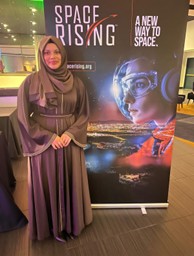
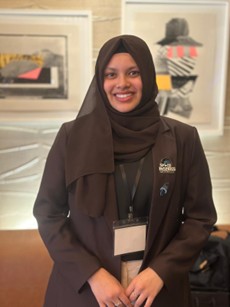
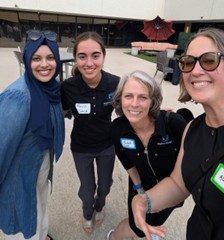
The day before the conference, I attended the Space Congress Welcome Mixer. I got to meet so many accomplished speakers, contributors, presidents, founders, CEOs, and people who see real potential in Arizona's future in space, understand the growing space economy, and know what needs to happen by 2030. What struck me most was that they took the time to listen to students like Alexis and me, marking ourselves through Higher Orbits. Before the mixer, I joined the pre-congress workshop with fellow SpaceKid Alexis, which was a simulation at the Defense Innovation OnRamp Hub. It taught me that more things than one boil down to cost optimization and funding (a $30 billion budget).

Even the most exciting missions have to answer the same hard questions about resources. That stuck with me.
After a few hors d'oeuvres and a good night's sleep, I carried those conversations right through the door with me. It was Congress day.
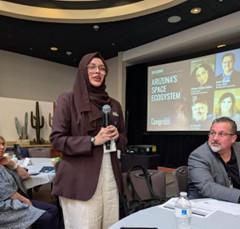

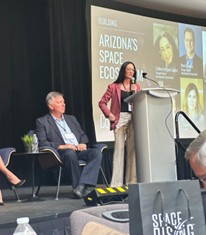
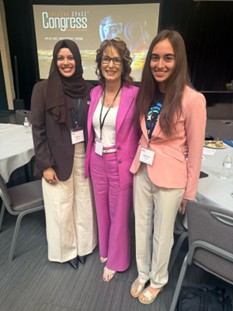
The first thing that struck me was the crowd. There weren’t just aerospace engineers or scientists. There were educators, students, artists, lawyers, policymakers, entrepreneurs, and storytellers. I met the CEO of the Barringer Crater up in Northern Arizona, someone who literally protects a piece of space history right in our own backyard. I also became connected with the executive producer of Ready Jet Go!, a show I grew up watching every single morning before school. Reaching her through Actor Erick Weiss felt like telling my childhood self that one day, I could be in a room with the person who helped put space on my TV screen. That conversation and video recording eventually reached PBS, all because I showed up and decided to try, not knowing how far a single conversation could take me.
I also met Colleen Garner, Director of Paragon Space Development Corporation, and Keynote Speaker, Charlie McGillis, CEO of 2 Polaris & Beyond. They shared stories about what space will look like someday and what it is already doing right now. Space exploration has already made an immense impact on the technologies we use every single day, and it’s the kind of impact you don't always see unless someone points it out. Listening to them, I realized that humans play the biggest role in the future of space. Technology is just a tool. The decisions, the curiosity, and the will to keep going all come from us.
That is the magic of this community. Every field can contribute to space. Every background has a place at the table, and Arizona has proven that over and over again. From our dark skies to our research institutions to the people who have been quietly building space history here for decades, we already have a long legacy. This conference made it clear that we also have the passion and the will to keep going.

There is still so much work to be done in Arizona, but being in that room, I felt nothing but momentum.
I also joined Michelle's session about Human Frontiers. She kept every response real and relatable, speaking directly to the audience like we were all having a conversation. At one point, I heard someone behind me whisper, "Damn, she's cool." I proudly smiled and nodded. Couldn't agree more. That is exactly the kind of leader she is. Someone who makes you feel like you belong in the room, not because you've arrived, but because she sees where you're going.
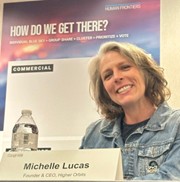
Shoutout to Taryn, Alexis, and Alice! It was so incredibly special to finally meet them!
Getting to sit down, learn from them, and share stories made the whole experience richer. That is what this network does. It connects you to people who get it.
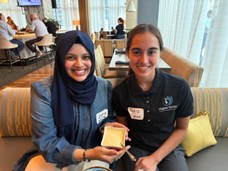
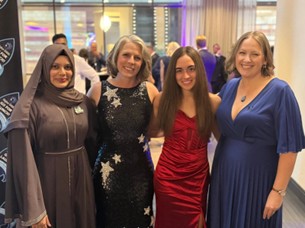
I had the privilege of speaking with so many attendees at the various sessions and at the gala who were genuinely curious about Higher Orbits and its mission. They wanted to know about the student experiments, the launches, and the community. And I think I can speak for both Alexis and me when I say that we loved sharing our stories and experiences with them. It reminded me why I have (officially) joined the Higher Orbits Queso Club, an iconic and wonderful Higher Orbits tradition that is exactly the kind of thing that happens when you find people who aren't afraid to be a little silly but care deeply about the same stars.

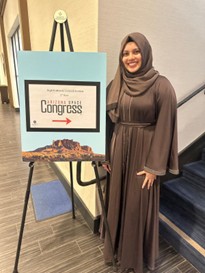
A few questions I had been turning over in my head finally got answered. Who writes the rules? Who secures the data? Who decides how we share the cosmos? That work matters, and marketing the future of space here in Arizona matters, too. How do you tell the story of what is happening in our own backyard? How do you get people excited, invested, and ready to be part of it? Those are the questions I want to spend my time on. Both fields are exactly what I want to pursue in higher education soon. The speakers and individuals
I met were already working in those fields. Hearing their stories and seeing how they got there cleared up more of my path than I could have hoped for.
Space is not reserved for one type of person. It never was. It is for the kid watching Ready Jet Go! before school. It is for the policy expert, the data person, the crater caretaker, the storyteller, and so much more. Arizona has the history, the heart, and the hustle, and after this Congress, I am more sure than ever that we are just getting started. I am grateful to Higher Orbits for letting me witness this new beginning.
The best is still ahead!
Written by Stellar Student Zahra Ali