When I walked into the Strauss Center at The University of Texas at Austin, I expected a purely technical introduction to the world of Space Traffic Management with topics like debris modeling, orbital congestion patterns, and international mitigation strategies. By the end of the conference, I began to see that the subtle nuances and differences in perspective were at the core of each discussion. Whether the challenge was voluntary data disclosure or defining ethical compliance, it became clear that our individual morality, reasoning, and judgement are what ultimately shape the technologies and systems we build. Out of all the possible limitations the industry could face, our own humanity emerged as the most significant.

From the moment the conference began, it was clear that this was not a room full of people trying to be “right.” It was a community advocating for holding multiple truths at once to explore novel perspectives. The atmosphere was collaborative, questions were welcomed, and uncertainties were acknowledged. Discourse was explored rather than dismissed. There was a shared understanding that our effectiveness in managing space traffic truly depends on open dialogue and collaboration. I was impressed and excited that discussions with others were seated in authenticity and a mutual willingness to explore complex ideas without rushing to oversimplified conclusions. Despite the gravity of the decisions being discussed, conference attendees spoke openly about the limits of current knowledge and the challenges ahead. In a field as complex and high stakes as space traffic management, that candor was both refreshing and inspiring.
Throughout the sessions, one theme surfaced repeatedly: orbital sustainability is not optional. With increasing satellite launches and growing congestion in LEO, the conversation has shifted from hypothetical concerns to urgent responsibility. Engineers, policymakers, and researchers bluntly addressed the need for stronger space domain awareness, improved debris mitigation strategies, and more coordinated regulatory frameworks. Space traffic management is not solely an engineering challenge. It requires coordination between international regulators, private companies, researchers, and governments. Technology alone cannot solve congestion, however, coordination via sharing of spacecraft positional data will result only from collaboration that is respectful, safe, and efficient. Many of the panel discussions reinforced the idea that responsibly managing what we build is just as critical as the act of building it.


The conference creatively organized speakers to present ideas sequentially to create a full story. Theme 5 in particular, "Theory & Constructs - As It Could Be,” shaped my perspective. A young professional speaking about orbital sustainability explained that regulators must learn to “mutually exist.” The idea was that there would never be one singular governing body with one unified perspective guiding all space activity. I was moved by her powerful distinction that international cooperation means coexistence rather than uniformity. During the panel discussion, her proposition that “environmental stewardship needs to be framed as economic risk mitigation" made positive global growth feel required and inevitable. Sustainable governance will not emerge from forcing consensus, but from acknowledging differences and building systems that function responsibly within them.
During the same panel, one presenter introduced a credit system that essentially gamifies orbital debris mitigation. This structure would serve as an incentivizing framework that rewards companies for actively removing space junk. It was fascinating to see sustainability framed not only as an ethical obligation, but as something that could be encouraged through behavioral and economic design. Innovation in space is not limited to propulsion systems or satellite hardware; innovation can also be defined by how we choose to motivate responsibility.
Beyond the formal sessions, I had countless meaningful conversations with both presenters and attendees during coffee breaks and passing moments. Everyone was eager to answer questions, challenge thoughts, and expand on ideas. These interesting conversations evolved into discussions about AI integration, data transparency, and the growing intersection of engineering and policy. Professionals treated student conversations with attention and respect, seeing us as present and future contributors, rather than just observers in the background. It was truly an honor to be treated with kindness and value amongst so many trailblazers and industry leaders.
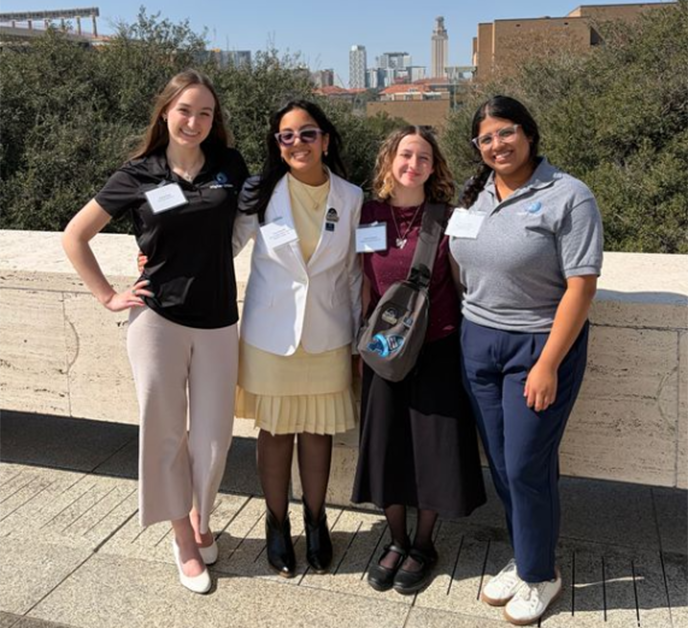
Finally, presenting alongside my fellow Higher Orbits alumni Eva, Josie, and Bri were especially meaningful. Hearing how the Go for Launch! Programs shaped the paths of my friends reinforced the power of early mentorship and the value of finding your “tribe”. When I attended my first Higher Orbits event in 2015, I had no idea how far those early lessons would carry me. Years later, engaging in discussions about international space policy proved that excitement and passion should not be curbed by intimidation or self-doubt. Higher Orbits instilled courage within me to try things I am intimidated by, succeed, fail, learn from it, then step forward an even better version of myself. It warms my heart that these ideals are what led me to grow into someone who embraces opportunities (like this conference!) with confidence and curiosity.
I had so much fun challenging myself at this conference and exploring new ideas with a community full of adept, insightful, and versatile industry experts. Ultimately, safe orbiting and coordinated space traffic management will not be a product of one company, organization, or nation, but will come from embracing collaborative individualism and practicing dialectical thinking. I am looking forward to the innovative and resounding solutions we will create.
Written By Stellar Student Kiera Fehr