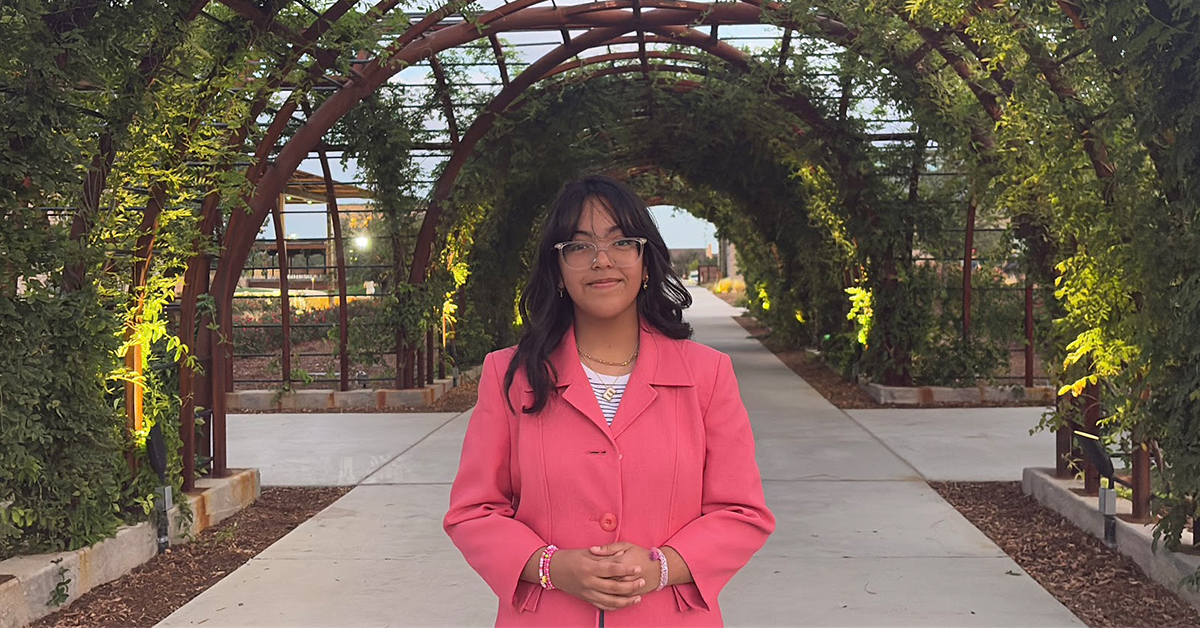
My name is Eva Estrada, and I am attending the 12th Annual Space Traffic Management Conference at UT Austin. I am originally from Venezuela, but for the past few years, I have lived in Midland, TX. I am extremely passionate about STEM, and I am deeply interested in research. Hence, I love conducting experiments and presenting them at science fairs and other competitions. However, in the last few years, I have found a new interest.
I attended my first Go For Launch! in 2024. Since then, I have attended four more events and have been involved with Higher Orbits as much as possible. This last summer, I attended and spoke at the AIAA ASCEND conference with my fellow Higher Orbits students. The experience was out-of-this-world, and I am ready for my next adventure. On February 18-19, I will attend and speak at the 12th Annual Space Traffic Management Conference at UT Austin with three other Higher Orbits students.
Space traffic management is one of the most important and growing fields within the space industry, and I am eager to join the conversation. Space traffic management includes the identification, tracking, and coordination of orbital debris. Unfortunately, due to the rapid growth of the space industry and the frequency of launches, low-Earth orbit is becoming more and more congested every day. However, this problem has many more layers. Space traffic management is deeply connected with space environmentalism. Thus, the problem goes far beyond space junk and into frameworks such as the circular space economy, which promote sustainability and prevent orbital debris. Along with that, no one really knows exactly where every single object is located in space, due to the fact that many countries like to keep part of that information protected for security matters. In addition to many other variables, space traffic management is far from a simple problem. Instead, it is more of a puzzle. Therefore, step one is to learn what the pieces are, before step 2, which is actually putting them together to build a solution.
My goal in this conference is to learn as much as I can and make meaningful connections with others. Luckily, the organizers of the 12th Annual Space Traffic Management Conference seem to have read my mind. First off, panels and speakers are divided into five themes, each regarding a different aspect of space traffic management. On top of that, they are organized chronologically, from the current state of LEO and the baseline issues with space traffic management, to the future we dream of. Simply put, the conference is organized perfectly to get to know the pieces and slowly put them together. Additionally, there are networking opportunities around every corner. Speakers and panelists (including the Higher Orbits group) will also attend a networking event at the end of day one. If that could not be exciting enough, looking at the agenda, it is unequivocal that the conference is not single-minded. Instead, it is an interdisciplinary overview of space traffic management. From the economy, international relations, security, technology, policy, etc. I am excited to sample these topics and dive deep into
my newfound interests. More than anything, I am even more eager for the Higher Orbits panel, and I can’t wait to hear everyone’s stories.
I am counting down the days for the moment I step foot in Austin. For my final remarks, I’d like to thank Higher Orbits for providing me with this opportunity. Most importantly, I’d like to thank Michelle for inspiring me to apply in the first place, and I hope this has prompted you to do the same. You can’t get it if you don’t apply, and you have nothing to lose and everything to gain!
Written By Stellar Student Eva Estrada