There are countless fields in science, each with their own unique perspectives and scopes of study. But one thing they all share is a relentless curiosity about the unknown. That curiosity is what first drew me to science, and what continues to inspire me as I learn how it can help solve some of the world’s biggest challenges.
My name is Alexis Simon, and I am a high-school sophomore from Arizona. Higher Orbits is an amazingly unique program that gives students a glimpse into the real world of space science and research. About two years ago, the program, run by founder Michelle Lucas, came to my hometown in Arizona.
I have always been interested in genetics, sustainability, and the environment because of my passion for protecting our planet and improving health. At the age of ten, during the COVID-19 pandemic, I spent many evenings looking up at the sky, using an app to identify planets, stars, satellites, and other celestial bodies. That experience sparked my love for astronomy and astrophysics. Space research creates an entirely new world beyond Earth, but it also proves incredibly useful for improving life here at home.
Being part of Higher Orbits has been an unforgettable experience. What began as a two-day workshop filled with hands-on activities and team brainstorming sessions turned into something I never imagined: my team’s experiment being chosen to fly to the International Space Station.
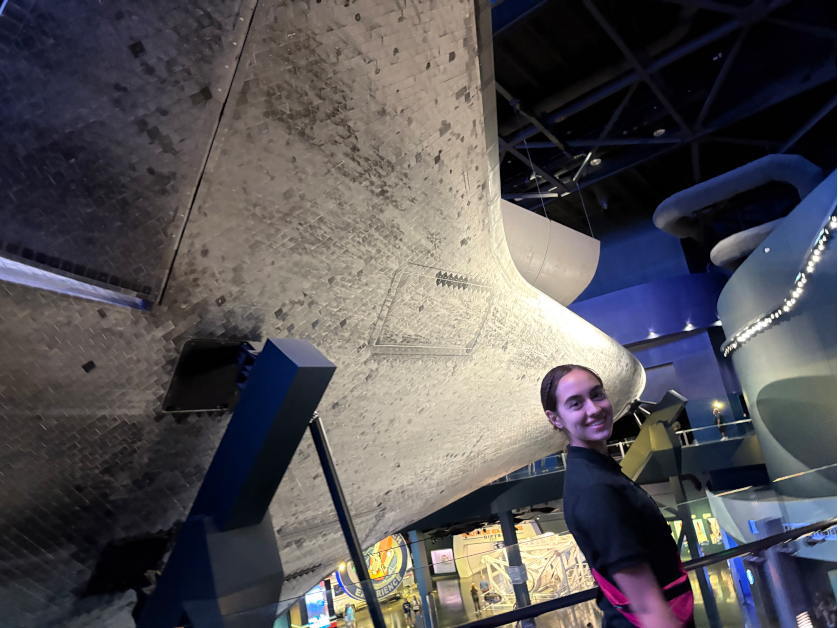
Our experiment tests the self-sustainability and growth of legumes in a closed-loop system in microgravity. After its launch, an event I was fortunate to witness in Florida, we were able to analyze the data in real time as it traveled through its mission on the ISS. Watching something that started as an idea become a real experiment in space has meant the world to me. I am still amazed that it is currently orbiting above us, sending back valuable data that can help shape a healthier, more sustainable future in space.
We sent green beans, the Provider variety, to examine their growth and root behavior in a CubeLab module. The experiment faced high carbon dioxide levels and lower oxygen than expected, which slowed the beans’ growth. Still, these unexpected results are scientifically valuable, and I am genuinely excited to present this data at the ASGSR Conference this December in Phoenix.
When I first heard about the conference, I was thrilled to hear it would be in Phoenix, AZ. I submitted my abstract, and within a few weeks, I received an email saying my abstract had been accepted for a poster presentation. I was thrilled and immediately began planning my poster.
As the conference gets closer, my excitement only grows. I hope to learn from professionals in the field, meet fellow students, hear their stories, and share mine. ASGSR is meaningful to me because it represents another opportunity to grow, be inspired, and continue exploring the world of space science with curiosity and passion.

I am honored to present our experiment alongside Higher Orbits, and I know our project would not have reached the sky without them. I am incredibly grateful to Higher Orbits, ASGSR, NASA, Space Tango, and the many others who made this experience possible.
To any students interested in science: keep moving toward your goals. They might be closer than you think if you stay curious, stay active, and get involved.
Countdown to ASGSR Phoenix!
Written By Stellar Student Alexis Simon