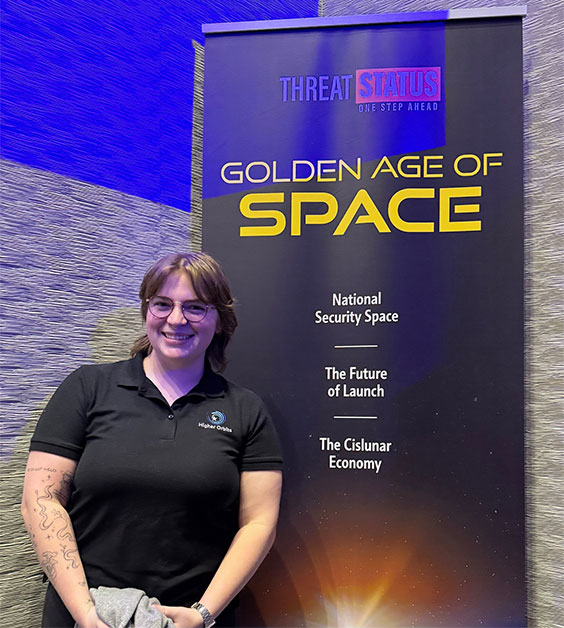
In the morning of November 17th 2026 I had the privilege of being an attendee to the first Golden Age of Space Conference presented by Threat Status with The Washington Times. This single day event, hosted in Washington DC, was broken into three segments with small fireside chats and keynote speakers sprinkled throughout. These segments were National Security, The Future of Launch, and the Cislunar Economy; each with its own set of panelists made up of individuals that all had a different hand in the manner.
This informative event started with opening remarks from Major General Stephen G. Purdy who helped break down what the word cislunar means and gave great insight as to why we as the American public should care about this portion of space. In simple terms, cislunar space is the 3-dimensional space between the Earth and the Moon, focused on the region surrounding our Earth-Moon system where both bodies' gravitational forces significantly interact with one another. This region of space is crucial because this zone is where offense and defense is played against outside threats. Major General Purdy reiterated Defense Secretary Pete Hegseth’s words in saying, “whoever controls cislunar space, controls the next fight”. What that next fight looks like and when it will come is still unknown but the focus of this Golden Age event was to give those directly involved in this effort a platform to speak on the current and future endeavors of protecting our nation and its people.
Before we got into the larger panels, we heard from current NASA administrator Jared Isaacman. This was my third time hearing Isaacman speak but first since he has taken on his new role as NASA’s 15th administrator! It was so great hearing from him and learning more about the current projects NASA has in the works and what past accomplishments have led us to where we are now. Something that he spoke on that interested me was the application of nuclear energy in future undertakings of NASA, with the declaration that the “next era of deep space exploration must leave the lab”. A prime example of this is NASA's Space Reactor-1 (SR-1) Freedom that is an upcoming pathfinder space mission scheduled to launch in December 2028. SR-1 is planned to be the first fission-powered interplanetary spacecraft to travel beyond Earth's orbit! I love that I am now (hopefully) a part of the generation that is going to watch the future of spacecrafts and life on the moon be driven by nuclear propulsion.
Sidestepping from space, Isaacman referenced their experimental X-59 Quesst aircraft that completed its first supersonic flight this past summer; this aircraft was designed for supersonic speeds and reduced sound of the typically loud sonic booms. While this aircraft, and NASA’s other X-planes, do not directly work toward controlling the cislunar space, it was pointed out that the first “A” in NASA is just as important as the “S”, that the lessons we learn and effort we put into non-lunar programs is just as beneficial in driving the work and support for cislunar projects.
The first mediated panel had a focus on National Security Space and we heard from individuals in high positions at Lockheed Martin, L3Harris, Vantor, and the Space Development Agency. It was engaging in hearing from Rob Mittrevski and the work that L3Harris is doing on the Golden Dome strategy and their efforts to provide a network of space-based sensors and satellites to act as a protective dome from external missile attacks. This missile defense protective network is the exact kind of thing that would exist in cislunar space and work to protect American soil and lives. A bit of space news that came out of this panel that I actually was not aware of was that the commercial spatial intelligence company Vantor captured an exclusion image showing the Russian military satellite Cosmos 2612 performing close-approach maneuvers near a Western commercial satellite earlier this year in October. Vantor was able to upload these images publicly and sparked the conversation around using commercialized information to deter enemies. A simple but effective tactic of showing everyone the tools we have and having possible threats stopped before they even start due to fear of failure. This act by Vantor is a prime example of something Deputy Director for GDA Marcia Holmes said during Golden Age for Space; that being that the US has the technology for a bright future, it has the processes, it has the manpower, but what we are missing is integration. There is a need for the connective tissue that holds all of these external factors in place and allows for information to flow and regulations to be made.
Holmes' keynote address led into the second panel that focused on the cislunar economy specifically and included speakers from AIAA, SpaceChain, and Peraton. There was a brief conversation around the desire to avoid creating another government agency or department to handle cislunar operations. Questions like “How do payment transitions work in space?” and “How are businesses regulated?” came up and evoked curiosity in me. I had never really thought about how things we see as standard down here will have to become standard somehow in space as well. Just as our cars need gas down here on the ground, future missions or even commercialized vehicles will need fuel resupplies up there as well. What will that look like and who controls that? Space travel, let alone defense, was so far off the radar when several nation-defining regulations were written into existence that we see now that there is a lot of work that needs to be done to include these new advancements.
The inaugural Golden Age of Space conference was a wonderful opportunity for me to attend as a young professional working in the defense sector as it gave me several points of views that I had never really considered before. It was exciting to attend a conference that was fully open to the public with so many high ranking individuals just tellin’ us as it is. And it was also great seeing all of the individual sponsors for this conference, further selling the point that the future of space and defense lies in collaboration. Thank you Higher Orbits for allowing me to attend and for being one of the STEM partners for this year’s event!
Written by Abi Youngker