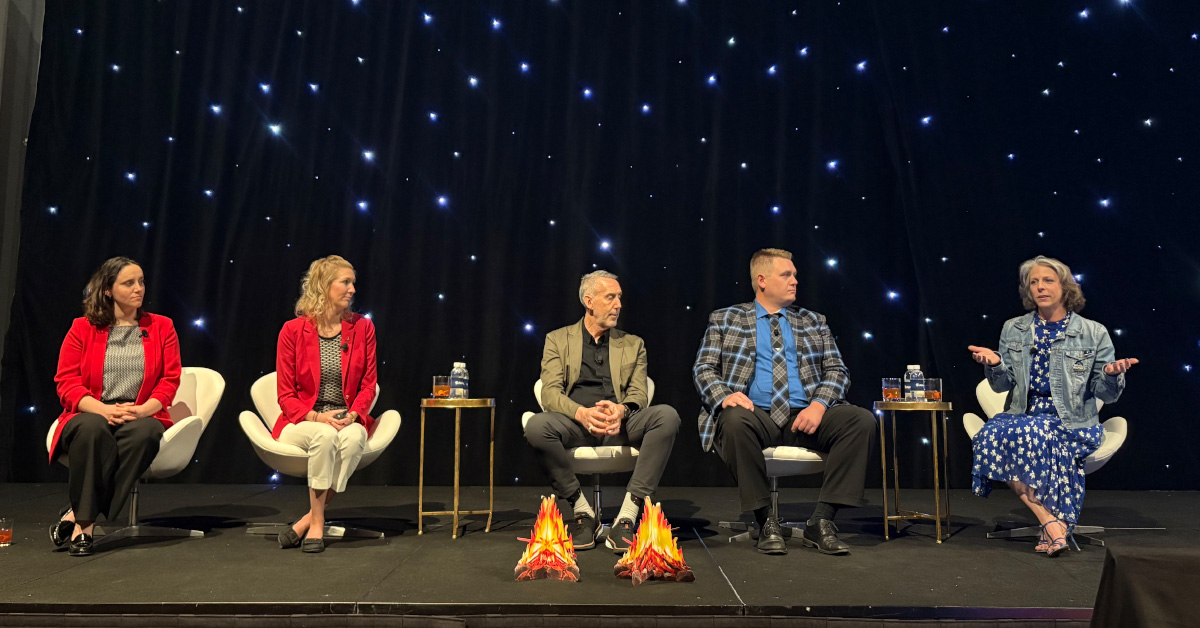
It’s been over a month since the AIAA ASCEND conference in Las Vegas and I am still buzzing with excitement and inspiration. This was my second conference with Higher Orbits, but it was an important first—I was on a panel with aerospace professionals as an aerospace (young) professional! A panel titled ‘The Things I Wish My Younger Aerospace Self Knew…’
In the lead up to the conference, I was quite nervous—what wisdom could I, someone who started full-time work only a few months ago, possibly have to share with a crowd of people who have been working in the aerospace world for their entire careers? But I trusted Michelle’s judgement in asking me to be on the panel, so I got to thinking: who was my former aerospace self and what advice would I give her?
My first conference with Higher Orbits was the 2019 International Space Station Research and Development Conference during the summer after I graduated high school. I presented a poster on my team’s Go For Launch experiment from 2017—bees in space! A lot has happened since then. I graduated college, did an internship at NASA Marshall Space Flight Center (MSFC), and got a full-time job as a Software Developer at MSFC supporting Space Launch System (SLS)!
But telling it that way makes it seem like I took a straight path from Go For Launch to NASA—and I didn’t. I didn’t touch anything space-related in college, unless you count taking multiple English courses on science fiction. I majored in Symbolic Systems, which is an interdisciplinary combination of computer science, psychology, linguistics, and philosophy, with a concentration in cognitive science. I did a minor in data science and an honors thesis at the intersection of developmental philosophy and artificial intelligence. During the first quarter of my freshman year at Stanford, I applied for two introductory seminars, one called “How to Design A Space Mission” and one called “Energy Options for the 21st Century”. I got into the energy one and not the space one, and that was that. I did a summer research internship in renewable energy, then took a gap year during the pandemic and worked at a health-tech/ed-tech startup. The following summers were spent interning at Google, then another renewable energy startup, then doing research in computer science and psychology. When I graduated, space was not at the forefront of my mind.
I applied for NASA internships to shoot my shot and see what would happen. What happened was I applied to 18 internships, didn’t hear back from 17, got one interview, heard nothing for three months, and in the end got one offer. Good thing you only need one! I was very excited. During my internship, however, I started to feel a bit out of place. Many of my peers in the intern cohort seemed to have come out of the womb knowing they wanted to build rockets. Most of them were aerospace or mechanical engineering students. Some knew the schedule of every upcoming launch or the names of every rocket engine. I fit none of those categories. I started to wonder if I wasn’t committed enough or knowledgeable enough to be in this field.
But at ASCEND, I started to realize that having a wandering path into aerospace is not as uncommon as I may have thought. At the conference, I had the opportunity to meet many interesting people working in different roles across the industry. I had lunch with a savvy businesswoman and space venture capitalist who has a law degree; I spoke with a senior scientist at NASA who worked for years in agriculture. Everyone had something to their backstory that was somewhat surprising or an unexpected side story waiting to be told.
My co-panelists exemplified this too. Lauren King, who is now a Strategic Communications & Mission Engagement Lead at Lockheed Martin, studied criminal justice. Nathan Zeien, now Director of Aerospace Services at Scot Forge, was a college athlete. Lee Rosen spent decades in the military before moving to private industry and eventually becoming ThinkOrbital Co-Founder & CEO. And Michelle, our fearless panel leader, did not instantly find her niche in training astronauts--or in inspiring the next generation of space kids!
What I took away from all of this, is that there is space for everyone in aerospace, pun intended 😉. If you want to be a part of the collective striving towards the stars, there is a place for you, no matter what skills or experience you bring to the table. You don’t need to dream about rocket engines to advance the field; you don’t have to be an engineer or a scientist at all to contribute to the mission. In fact, the three sessions at ASCEND that stuck with me the most were about successful business models of space startups, the history of Las Vegas as a template for Lunar economies, and the influence of science fiction on real technological breakthroughs.
Yes, I am working as an engineer now, but maybe in the future I will start a company or work in education. Many people I met started as one thing and found their niche elsewhere. We need smart business people, clear communicators, and passionate educators just as much as engineers and scientists--people who can translate the complicated language of technical specialists into content that is easy to understand for the everyday person, people who know how to think creatively and spot overlooked opportunities, people who can get students and the general public excited and inspired to pursue the next frontiers of space advancement.
In short, we need YOU, whoever you are.
So, I’ll repeat the advice I gave at the panel: every seemingly random skill or arc you pursue will return to you in unexpected ways. No passion is wasted. Technical skills I learned from a class on neuroscience and virtual reality have come in handy at my job at NASA. The clarity of writing I refined through English and philosophy coursework made my applications stand out from the crowd. Passion projects in photography and laser-cut art have helped me network with colleagues. The point is, don’t be afraid of deviating from the “traditional” path; don’t hold back in following what excites you. There is a place for you in aerospace no matter your background, if you want it.
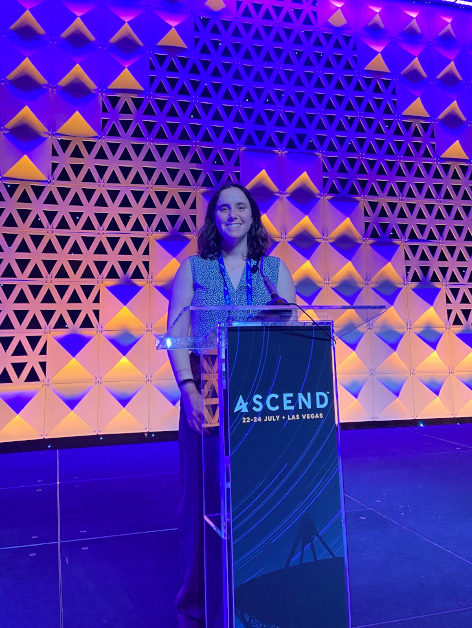
I am just at the beginning of my career, and who knows where the future will lead me. Who knows where the future will take you, whatever stage of your career you may be in. What I do know is that the space industry needs more than just engineers and scientists, and we can only go far if we go together.
My endless thanks to Higher Orbits for giving me this opportunity and so many others. Higher Orbits is an organization truly committed to inspiring every student to look towards the stars, no matter their background or interests.
Written By Stellar Student Sarah Bloom