From Microgravity to New Ideas: My Higher Orbits Go For Launch! Experience
Higher Orbits Launch — Norwich, 2024
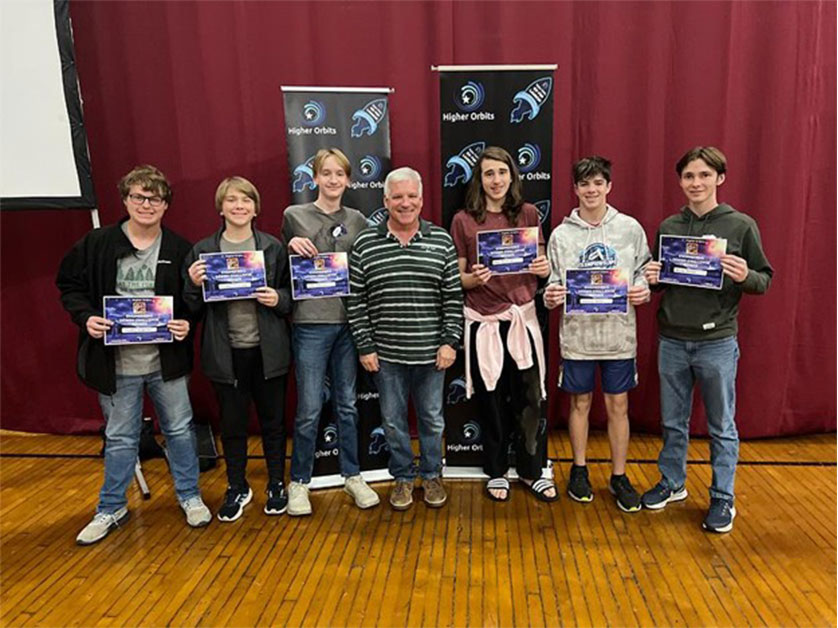
In 2024, I had the opportunity to attend the Higher Orbits Go For Launch! program in Norwich. It was a chance to explore science and engineering in a different way, especially by thinking about how experiments and everyday processes can change in space. I went into the experience interested in learning more, but I left with an even stronger interest in engineering and the kinds of problems engineers get to solve.
One of the activities that stood out to me focused on how precipitation is affected by microgravity. It was interesting to consider how a process that we are used to seeing on Earth might behave differently when gravity is not acting on it in the same way. The activity showed me that conducting an experiment in space is not simply a matter of repeating something that works on Earth. Scientists and engineers have to think carefully about the environment, how materials behave, and what they need to measure. A small change in conditions can lead to different results, which makes testing and problem-solving especially important.
The team challenges were another memorable part of Go For Launch! Working with other students meant listening to different ideas, communicating clearly, and figuring out how to approach a problem together. Not every challenge has one obvious solution, so it was useful to try ideas, make adjustments, and learn from the process. It gave me a better understanding of how engineering often involves collaboration as much as technical knowledge.
I also learned about thermophiles, organisms that can live in very hot environments. Learning about life that can survive under extreme conditions made me think about how much there still is to discover about living things and the environments where they can exist. It also connected to the bigger questions that come up when people study space and consider what conditions might support life.
Looking back, the most important part of the experience was how it expanded my view of engineering. Before Launch, I was interested in how things are designed and built. The activities helped me see that engineering also involves asking questions, testing possibilities, understanding science, and working with other people to solve unfamiliar problems. I especially enjoyed seeing how scientific ideas could connect to real experiments and challenges.
Higher Orbits Launch in Norwich was an experience that encouraged me to keep exploring STEM. I came away with new things to think about, including microgravity, thermophiles, and the teamwork behind solving engineering problems. Most importantly, it strengthened my interest in engineering and made me want to keep learning about what engineers can create and discover.