
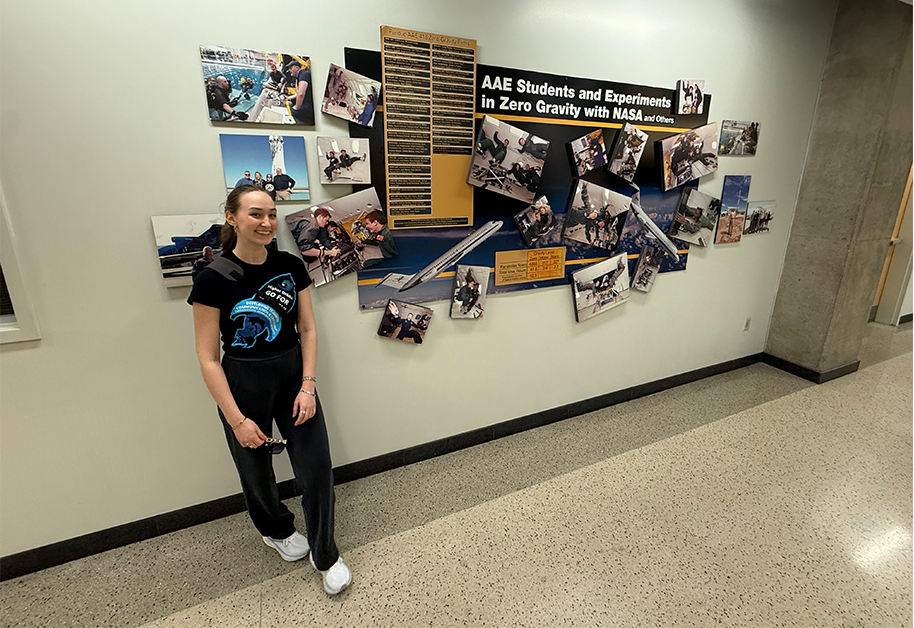
Attending the Space Policy, Science + Technology Symposium at Purdue University was a very exciting experience and challenged me to weigh perspectives from military, government, and academia perspectives. I loved attending the workshop sessions with industry experts and hearing all the amazing panel presentations.
Going into the symposium, I was primarily interested in space debris as a sustainability and engineering problem. My focus centered on core materials, system behavior, and long-term impacts in orbit, and I was excited to learn more about how those ideas connect to policy. After attending the Space Traffic Management conference with Higher Orbits in Austin, my mind was filled with Kessler's Syndrome and the environmental impact of massive amounts of debris in orbit. Although I understood that international collaboration would be crucial to mitigating environmental concerns and encouraging good cleanup practices, I hadn’t fully considered that these goals are secondary to national security priorities.
Throughout the symposium, space debris was consistently discussed not just as a technical or environmental issue, but as a national security risk. It was a good reminder that although some technical solutions may sound obvious to an engineer, practicality of a solution doesn’t always translate to international policy and national regulations. Discussions around military readiness, strategic advantage, and contested space environments introduced a perspective that explained why iterative solutions aren’t as easy to implement as some academics may jump to believe.
I’ve always been drawn to space because of its potential for discovery, innovation, and collaboration. Hearing it discussed through the lens of conflict and defense forced me to confront a reality that I hadn’t fully engaged with before: space is not separate from geopolitical dynamics and funding is often shaped by many actors. At the same time, I began to understand why this perspective exists. The growing reliance on space-based systems for communication, navigation, and infrastructure means that disruptions in orbit can have widespread consequences. Space debris, in this context, is not just about creating sustainable infrastructure but is also about protecting systems that people depend on every day. That realization helped me create a visual map of how technical challenges, policy decisions, and security concerns are deeply interconnected.
One of the most meaningful takeaways for me was recognizing that these conversations are not one-dimensional. While national security was a dominant theme, there were also underlying discussions about responsibility, coordination, and long-term orbit infrastructure. Addressing space debris requires a collective devotion to protecting individual assets in orbit and managing a shared environment that no single entity controls.
Although each large scale discussion was captivating, I found myself returning to the technical side of these challenges. Understanding how materials degrade, how debris forms, and how systems behave over time is essential to addressing the problem at its source. Thankfully, we are alive in a period of time where our scientific community can identify and improve many of these limitations. I feel that including policy, strategy, and diplomacy into technical research can make the transition between academia, commercial, and national applications a bit smoother. It was encouraging and exciting to see that very idea exercised throughout the conference.
It was a delight to be pushed to think critically about how space is used, who national policy serves, and how ethical decisions are made. I’m happy to say that I am leaving this experience with a deeper understanding of how development in the space sector engages both exciting possibilities and complex challenges. It also reinforced something important for me personally: that it’s possible to be part of these conversations while still holding onto the values that drew me to space in the first place.
As space continues to evolve, so will the conversations surrounding it. I’m grateful to have been pushed to think in ways I hadn’t before. I look forward to the future of new solutions and frameworks designed for orbital maintenance and intelligence.
Written By Stellar Student Kiera Fehr