
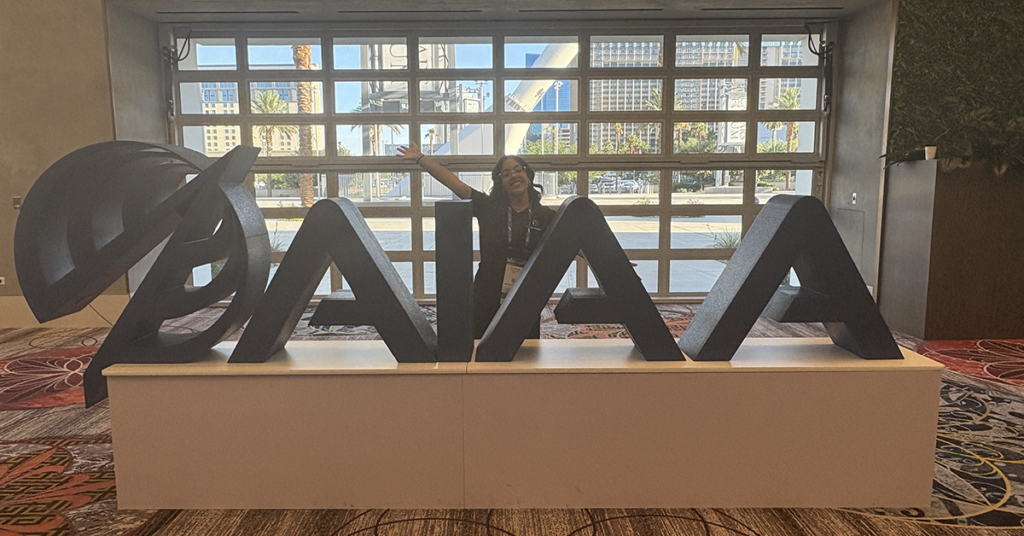
Well, well, well… how the time flies. Hi! I’m Eva Estrada, and I am back here for my third conference with Higher Orbits and my second time at this event. From May 19th to 21st, I will be in Washington, DC, with Michelle and fellow Higher Orbits student Ava for AIAA ASCEND!
I attended my first Higher Orbits event in 2024, and my life has not been the same since. As a STEM enthusiast, I have always loved exploring life sciences such as microbiology and biochemistry, even going so far as to conduct my own independent research. At the time, though, I never thought of myself as being part of the space industry. It wasn’t until my first conference, AIAA ASCEND, that I realized how diverse the space industry is. From space medicine, policy, law, economy, technology, and safety, ASCEND was the perfect place for me to dip my toe in the water of a variety of fields. Now, I return to continue the story and learn about the next chapter of aerospace.
My time at ASCEND last year is best described as a turning point. As I mentioned, this conference allowed me to explore every corner of the space industry and hear the stories of people who have walked those paths multiple times. When I returned home, I came back with more than just an experience; I came back with a new North Star.
Before ASCEND, I had never heard of the field of space medicine, but after, I couldn’t get enough of it. I was fascinated by the nuances of the human body in microgravity and how healthcare is turned upside down (just like astronauts!). I also developed an interest in how life forms in general behave in the space environment, which leads to my curiosity both about Earth-based and extraterrestrial life (Project Hail Mary vibes?). After ASCEND, I attended the IAA Space Traffic Management conference at UT Austin last February. This experience helped me hone in on one topic, that being space traffic management and orbital awareness. Here, I learned the ins and outs of what, where, how, and why we have so much “space junk” and the current efforts to reduce it. I am excited to see these topics presented on the big stage in Washington, DC.
In terms of ASCEND 2026, I could not be more excited. This will be my first time in the
U.S Capital, so I am willing to make it count. Thus, my family and I will be staying a few days prior to the conference to fully enjoy the wonders of DC. My plans include (but are not limited to): National Mall, Tidal Basin, Capitol Hill, the White House, and of course… the National Air and Space Museum! Let’s also not forget the exquisite and diverse food scene. Along with that, I will be reuniting with some family in Maryland, so I can’t wait to explore the area with them as well.
Furthermore, I am extremely eager for the Higher Orbits panel. I am excited for the Higher Orbits group to tell our story and reassure the fine people at ASCEND that the world will be in good hands. Even more so, I can’t wait to hear Ava’s STEM journey (as far as I can tell, we have so much in common!). And of course, it is always nice to hear Michelle’s stories as well. I believe our time at The Hub will be a great opportunity to show people just how driven and passionate the next generation is. With that, it is important to mention the people who have gotten us thus far, who have shaped our futures, and cultivated our curiosity (AKA Higher Orbits).
In terms of the conference itself, I think this is a very exciting and unique time in the industry. With the Artemis II mission still fresh on our minds (and hearts), I can’t wait to hear the discoveries and lessons learned from this historic flight. My biggest hope is that we get to hear these updates from NASA Administrator Jared Isaacman himself… so I will update you on that. As I am looking over the program, it is evident that many panels follow up on Artemis II with topics such as lunar infrastructure plans and exoplanet science. One specific panel from Lockheed Martin discusses the Orion spacecraft and how this monumental piece of technology was specifically able to execute the Artemis II mission. Another important movement in the industry is the estimated de-orbiting of the ISS in 2030. This has sparked intense conversations on what the ripple effects of this process may be. It is unknown to us whether this event will stifle innovation and microgravity research, or if it will open the door to a new era of commercial space stations. Regardless of the outcome, companies are competing in a last-man-standing battle of who will own the ultimately successful commercial space station. I currently do not hold an opinion on who will be the supposed “winner,” but I feel confident that my time at ASCEND will give me a better idea of what the current vision is for microgravity research. At the same time, the industry is working on looking back and gathering the lessons learned from over 27 years of groundbreaking discoveries in the ISS. Thus, I will definitely be attending a variety of sessions hosted by the ISS National Lab that center around the past, present, and future state of microgravity research, and the different strategies to move forward rather than backward. I am especially excited to attend a panel titled “ISSNL: A Microgravity Laboratory of the Future” with our dearest Michelle Lucas. This will be a great moment to hear different perspectives on how we will maintain constant innovation and a thriving LEO economy.
But of course, I could not forget about the space medicine and astrobiology sessions. Luckily, there is no shortage of these at ASCEND. This includes a spectrum of technical paper sessions that explore how everything we seem to understand about life is distorted in space. Most importantly, many of these panel sessions focus on developing from the research phase to creating real-world solutions. This includes the commercialization of the space healthcare market and space-based biomanufacturing. However, the session that catches my eye the most is one titled “Using the ISS to Outwit Cancer.” If that does not sound interesting enough, this session explains how model systems have helped people on Earth understand the effects of natural aging and how that progression can develop into cancer.
We are in an unprecedented and never-before-seen era of the space industry, and I am ready to join the conversation at ASCEND. This conference is an opportunity to visualize a future with Artemis, no ISS, more AI, international perspectives, and higher interdisciplinary collaboration. I am filled with anticipation for what I know will be another magical and life-changing time with my Higher Orbits crew. Thank you so much to Michelle for trusting me again with another once-in-a-lifetime opportunity. I am honored and incredibly grateful to be part of this space family. As always, I hope this blog has inspired you to take a chance on yourself and apply for something. As a very wise woman once said, “You can’t get it if you don’t apply!” Thank you so much for making my summers out-of-this-world, and I can’t wait to tell you all about my adventures in DC!
Written By Stellar Student Eva Estrada