
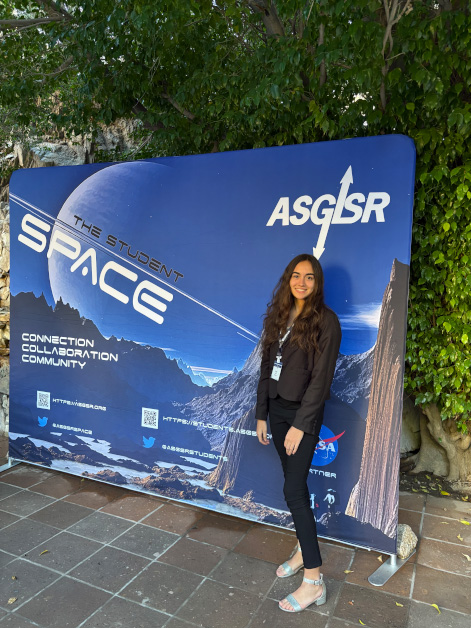
This year’s ASGSR Conference in Phoenix, Arizona, was one of the most informative, inspiring, and unforgettable experiences I have ever had. Whether I was attending sessions, meeting leaders in the field, or presenting my own research on legume self sustainability in space, I felt surrounded by passion, curiosity, and endless possibility. ASGSR plays an important role in the scientific community by bringing together new technologies and discoveries actively being tested and used in space, while educating attendees on emerging findings within the gravitational and biological sciences. I am deeply grateful to have met so many incredible people, each contributing to space science through their own unique and diverse areas of expertise.
My first day at the conference was exceptional in many ways. I met scientists and engineers from across the country, all pushing the boundaries of space exploration, engineering, biology, genetics, and cancer research. Speaking with such passionate individuals was both educational and profoundly motivating. These conversations expanded my understanding of what is possible and strengthened my desire to work at the intersection of genetics and space.
Throughout the conference, I attended sessions led by keynote speakers, CEOs, scientists, and pioneering researchers. I learned about new discoveries, emerging technologies, and the future directions of space research. Many sessions offered insight into careers in the space industry and, in some cases, within NASA itself. I also enjoyed the meet and greets, where I connected with students and experts who also shared similar interests. Some of my favorite moments came from the fireside chats, where speakers shared their journeys, challenges, and advice directly with students. One highlight was holding and learning about a microfluidic lab on a chip, an incredible technology with fascinating potential for future research.
Throughout the conference, I visited several student poster presentations and learned from experiments that had also been flown to the International Space Station. Their research ranged from studying space radiation to investigating organisms that could play important roles in future missions. Hearing about the persistence behind each project reinforced how much patience and dedication space research requires, as none of this work happens overnight. Meeting others who shared my interests and passions was one of the most meaningful parts of the conference.
Later, I presented our experiment on the growth and self sustainability of green beans aboard the International Space Station. Our goal was to better understand how microgravity affects the growth and long term sustainability of legumes in space. Although the experiment came with challenges, those challenges made the results even more valuable. I learned that even small and unexpected variables can change significantly in space, making experiments difficult to control, yet every outcome still serves a purpose. Sharing this project, which means so much to me, was an absolute joy, and I am incredibly grateful for the thoughtful and constructive feedback I received.
Being surrounded by so much inspiration was truly special, and speaking with everyone there was an honor I will carry with me for a long time. I am grateful to Space Tango, NASA, Higher Orbits, Michelle Lucas, and everyone else who made this experience possible.
Leaving ASGSR, I feel more inspired than ever to continue learning, exploring, and discovering in this field. I am thankful for the opportunity to represent Higher Orbits and to present data from an experiment that made its way to space. This experience strengthened my passion for space science and reinforced my interest in using genetics to contribute to future research. To fellow students, my advice is to continue meeting new people and following your passions, because they may lead you to opportunities and places you never expected
Written By Stellar Student Alexis Simon